Now in beta · behaviour intelligence for digital wellbeing
Understandyour digital life.And your family's.
See your digital life clearly, what it's giving you, what it's costing you, and your kids' too.
✓You're in the queue. We'll email you an invite when the next wave opens.
The first beta is live and in testers' hands. Join the queue and we'll invite you in with the next wave. Built privacy-first, no spam.
Why we're building this
We're living through one of the largest behavioural shifts in human history, and flying blind through it.
Social media is engineered for engagement. AI is accelerating dependency. Yet we have almost no useful way to understand what our digital behaviour is telling us about our attention, relationships and wellbeing, or whether any of it is making our lives better or worse.
~⅓
of your waking life is now spent on a screen. You rarely know what that time was actually made of.
DataReportal / Statista, 2024
38%
of adults sleep worse because of bedtime screen use, rising to 46% in under-25s. None of us are immune.
Amer. Academy of Sleep Medicine, 2026
13%
higher risk of depression in adolescents for each extra hour spent on social media each day.
Dose-response meta-analysis, 2022
Digital behaviour is a powerful, largely untapped signal of human wellbeing. Your devices already capture the patterns. ThirdLife turns them into insight that helps you, and your family, live better.
What you'll seeIn the beta now
Five ways to see your digital life clearly.
Not a screen-time counter, but a read on what that time is actually doing for you.
Overview
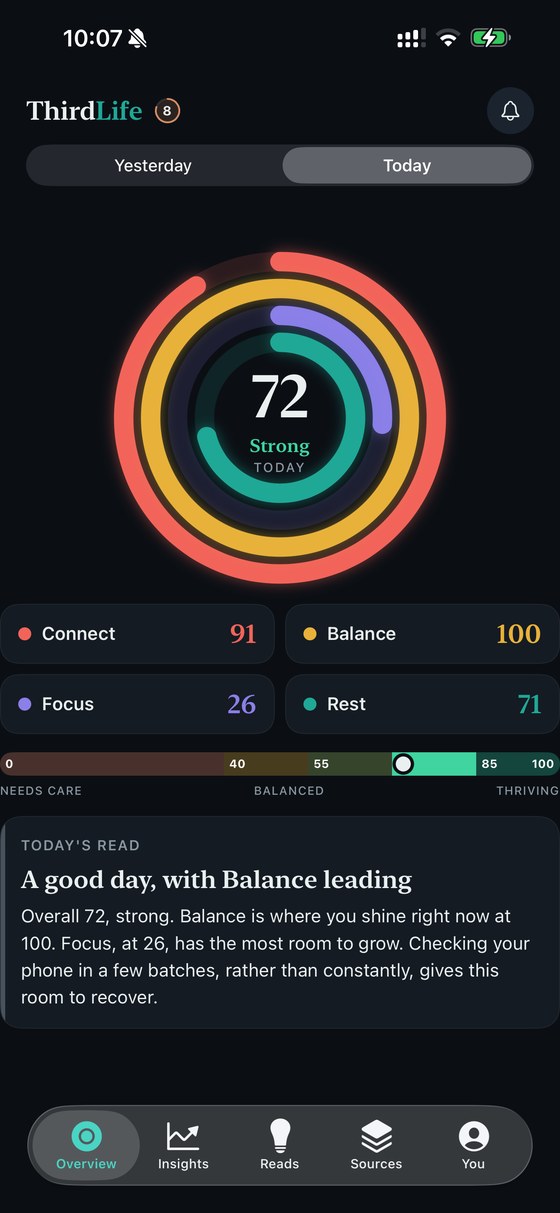
Your whole day distilled into four rings, Connect, Balance, Focus and Rest, and one honest overall score. Not how long you were on your phone, but what that time was actually doing for you.
Insights
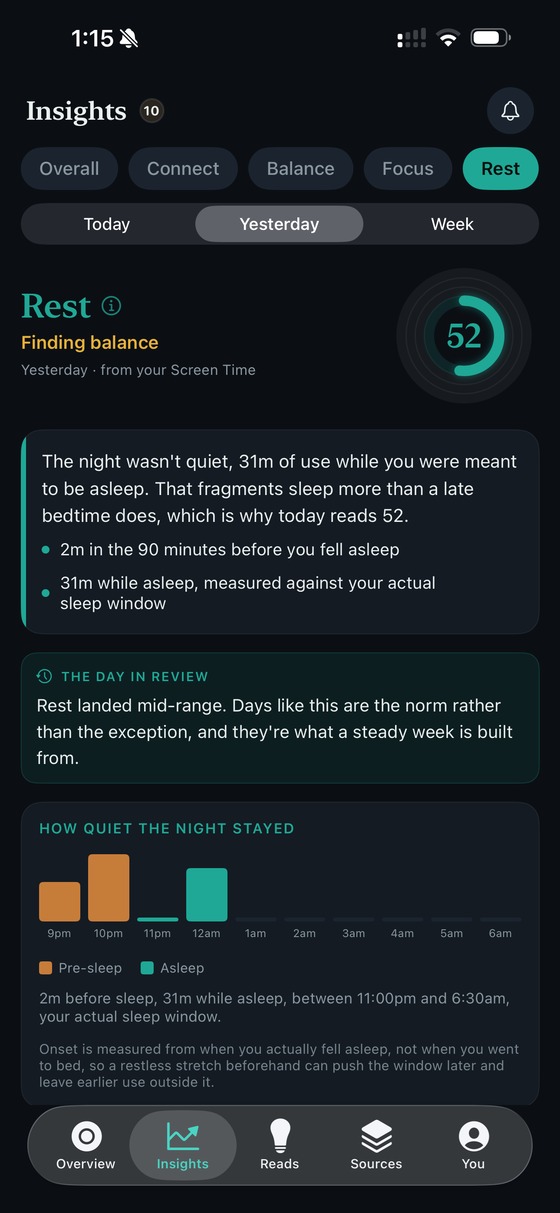
Every score comes with the "why" behind it. See what's lifting each ring and what's quietly draining it, so the number is never a mystery and always tells you where to look.
Reads
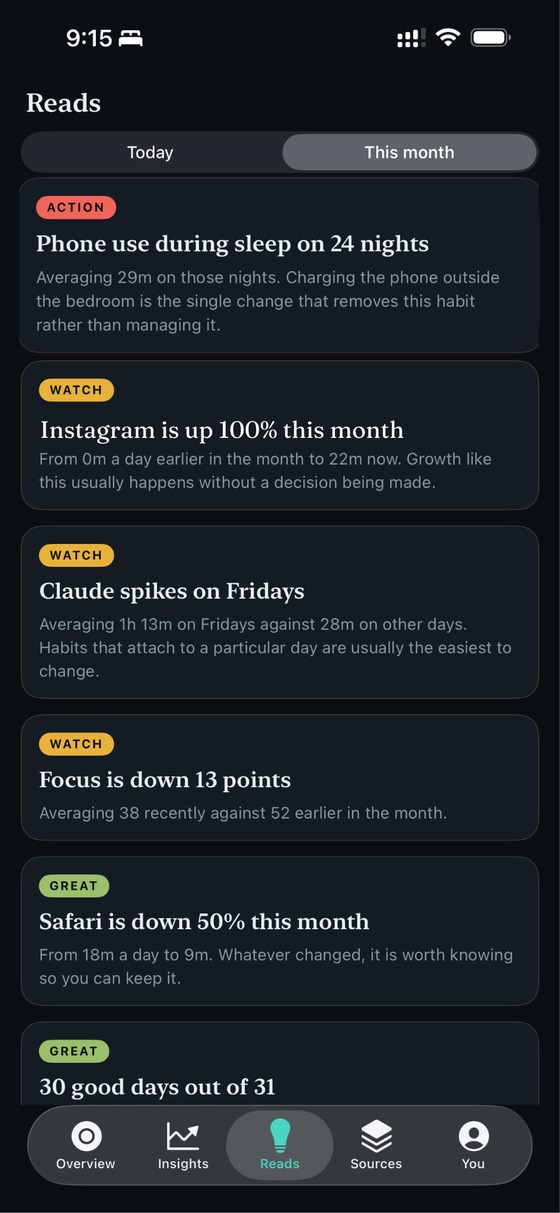
The patterns you'd never spot yourself, surfaced in plain language and graded by how much they matter. Your screen time, finally telling you something instead of just counting.
Sources
The more ThirdLife knows, the sharper it gets. Connect your wearable and other signals so your scores reflect your real life, your actual sleep, not a guessed bedtime.
Milestones
Change is hard to see day to day, so ThirdLife marks the wins. Gentle recognition for the days and weeks things go well, built to encourage rather than to hook you.
At a glanceIn the beta now
Four rings and an overall score. One honest picture of your day.
Connect, Balance, Focus and Rest, each scored out of 100 and rolled into a single daily score, filling toward gentle targets that reset each day. A clear, unshaming read on the things that shape your digital wellbeing, with a plain-language note on what led the day. Targets are being calibrated with behavioural-science input, not picked at random.
InsightsIn the beta now
Then go deeper, one ring at a time.
Tap any ring to see how it's tracking, today, yesterday or across the week. Insights shows what's lifting the score and what's draining it, with trends and charts, and the single change most likely to help, in plain words rather than raw numbers.
Overall and each of the four rings, broken down
What lifts it, what drains it, and one thing to try
Trends and charts across today, yesterday and the week
ReadsIn the beta now
Not a dashboard to decode. A read on your day, and your month.
ThirdLife turns raw screen-time signals into intelligent findings you can act on, graded so you know what's worth your attention and what's already going well.
Great and Good for what's working, so you can keep it
Watch and Action for the patterns worth a change
Specific, not vague: named apps, real minutes, actual days
And if you're a parent On the roadmap
The same understanding, coming for your kids too.
Once you're seeing your own digital life clearly, the real worry is often your children's. The plan: add a child's device and get a meaningful, pattern-level view of how they're really doing, without reading their messages or fighting over screen limits.
Themes and trends, never their private messages or who they talk to
Graded safety alerts that tell you what's actually worth acting on
Age-graduated and consent-based: your child can see what's shared
One view across media, sleep, AI use and safety, for each child
Maya's weekMMaya, 14 ▾
Phone use during sleep on 29 nightsAction
Averaging 47 minutes on those nights this month. Charging the phone outside the bedroom is the single change that removes that habit rather than managing it.
Instagram spikes on FridaysWatch
Averaging 109 minutes on Fridays against 42 minutes on other days. Habits that attach to a particular day are usually the easiest to change.
Leaning on AI for homeworkWatch
Over half her AI use this week was answer-seeking on schoolwork, the kind where it's doing the thinking. Worth asking her to walk you through a recent assignment.
A flatter week than usualWatch
Her rhythm suggests a quieter, lower mood this week. Nothing alarming on its own, but a warm conversation could help.
We surface a flag, never the message. Maya is told when one is raised.
How it works
Understanding, not surveillance.
Setup takes a minute. It starts with the same screen-time signals your phone already collects, and anything deeper is unlocked only with your explicit consent. Adding a child's device works the same way, with their awareness.
Private by design
Everything runs on the device. None of your screen-time data or insights ever leave the phone.
Trust, not spying
If you add a child, you see patterns and themes, never private messages or contacts. They know what's shared, and it grows with their age.
Grounded in science, not guesswork
Our wellbeing benchmarks and classifications are being developed with behavioural-science and clinical expertise, so the guidance you get is considered, not arbitrary.
Honest, not addictive
A tool designed to be needed less over time. The opposite of the apps it helps you understand.
Beta access
The beta is live. Join the next wave.
Our first cohort is already using ThirdLife. We're opening more places wave by wave. Join the queue and we'll invite you in, and your family if you want it.
Built privacy-first. No spam, just your invite when a place opens.
Building this with you. If there's something you'd love ThirdLife to help you understand, for yourself or your family, tell us at info@thirdlifeapp.com.